
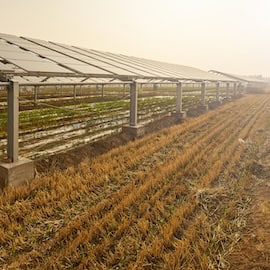
As India rapidly scales up solar energy, a critical question has emerged: Can this transition deliver clean power without displacing farmers from their land?
India’s renewable energy transition started with the goal of reducing dependence on fossil-fuels and promoting carbon-neutral and clean alternatives. In the past decade, the country has seen tremendous growth in its renewable energy sector. The installed capacity of renewable energy has increased rapidly from ~36 GW in FY 2013-14 to ~274 GW in FY 2025-26. In this mix, solar power owns the largest share, with an installed capacity of ~150 GW as of FY 2025-26.
However, this expansion has mainly been led by large, ground-mounted solar projects, often located on agricultural land. While effective in scaling solar capacity, this model has also created an unintended structural disconnect between India’s energy and agriculture sectors. Productive agricultural land is frequently diverted exclusively towards energy generation for projects with projected lifetimes of 20-25 years, thereby limiting its use for cultivation and affecting livelihood opportunities for farmers.
Alongside this shift in land use, farmers’ participation in energy generation has remained limited. Agriculture remains one of the largest consumers of electricity in India, yet farmers have only played a minimal role as decentralised energy producers. In 2019, the Indian government launched the Pradhan Mantri Kisan Urja Suraksha evam Utthan Mahabhiyan (PM-KUSUM) scheme to address this gap by promoting decentralised solar capacity in the agriculture sector. It has three components: Component A supports decentralised, grid-connected solar plants owned by farmers or farmer collectives; component B focuses on standalone solar pumps; and component C addresses the feeder-level solarisation of grid-connected pumps.
Among these three, component A holds the most promise from an inclusive business model perspective. It enables farmers to sell surplus power under long-term power purchasing agreements and opens the door to stable income streams. Yet despite its strong conceptual design, component A has faced implementation challenges, including slower-than-expected uptake and a tendency for farmers to opt for land-use conversion, where their agricultural activity is discontinued in favour of solar generation.
These challenges highlight a deeper limitation in India’s current approach: Namely, its efforts to boost renewable energy use among farmers continue to separate energy expansion from agricultural livelihoods. This makes a compelling case for a different model, one that does not force a trade-off between the two.
Agriphotovoltaics (Agri-PV) offers exactly that possibility, by co-locating solar photovoltaic systems and agricultural production on the same parcel of land to reconcile energy generation with agricultural continuity. By elevating solar panels and optimising their spatial configurations, Agri-PV enables the cultivation of crops beneath or between panel arrays, facilitating dual land use.
However, in India, this idea is still at an early stage, and it continues to place insufficient emphasis on crop yield and farmers’ livelihoods. To realise its full potential, we argue that Agri-PV should be understood not merely as a renewable energy innovation, but as an inclusive business model with transformative potential for low-income farming communities across the country.
Agriphotovoltaics as a farmer-centric innovation
With the agriculture sector employing 46.1% of India’s workforce, it is critical to design Agri-PV as a farmer-centric solution, in which land becomes a dual-use asset rather than a competing one. At its core, the goal of this approach is simple: to allow solar panels to generate electricity while farming continues alongside (or underneath) them. In this model, solar power effectively becomes a highly remunerative “crop” in itself — one that provides predictable income to farmers, regardless of any crop failures or market fluctuations. Beyond income diversification, Agri-PV can also offer micro-climatic benefits. Partial shading can reduce water loss from both the soil and plants, regulate temperatures, and improve soil moisture conditions, potentially enhancing crop resilience.
However, the technology alone is not enough. What ultimately matters is who owns it, who finances it and how is it governed. When farmers retain land rights and participate directly in energy revenues, Agri-PV can act as an inclusive business model that augments their income substantially.
The Current Reality of Agri-PV in India
Currently in India, Agri-PV has three distinct operating models, each with different implications for the inclusion and equity of farmers.
Model 1: R&D-led demonstration projects which are typically installed by research institutions. They largely run-on grant funding, and play a key role in generating agronomic insights, particularly on crop performance under solar panels’ shade across different climatic zones. The main goal of this model is to create proof of concept rather than to directly promote rural livelihood.
Model 2: Developer-led models, which are operated by private developers who lease agricultural land from farmers for 20-25 years, then install Agri-PV systems and manage both the energy and agriculture production. The farmers receive fixed annual rental income, while the developers retain ownership of the Agri-PV system and gain revenue from crop and energy sales. This rental income is often higher than traditional crop income, but it represents only a fraction of the total value generated from energy and high-value agriculture production.
Model 3: Farmer-owned models under PM KUSUM’s component A, which enables farmers or farmer producer organisations (FPOs) to own the Agri-PV system directly. In this case, farmers can install the system on their land, sell electricity directly to the grid under long-term power purchasing agreements and continue cultivating under the panels, thereby retaining income from both sources.
The fundamental difference between these models is about who controls the Agri-PV assets and who captures the value they generate. As Agri-PV scales in India, the choice between these models will determine whether this innovation becomes a pathway for rural livelihoods or not.
Viable Farmer-Centric Business Models
To understand how more farmer-centric models can work into practice, we looked at two emerging examples from different parts of the country. Once such case is in Jaipur district in the state of Rajasthan in western India, and the other in Koraput district in the state of Odisha in eastern India.
1. Rajasthan’s Agri-PV Model
In Rajasthan, an existing ground-mounted solar PV plant was retrofitted into an Agri-PV system under the PM-KUSUM framework, supported by our organisation, Indian Council for Research on International Economic Relations (ICRIER). This involved increasing the level of the panels by installing mounting structures to a height of 3.5 metres above the ground to enable agricultural activity under them. Given that Agri-PV is more capital-intensive than a ground-mounted PV system, this transition required ICRIER to provide around 15% of the total setup costs of this Agri-PV pilot. Our analysis suggests that this ~15% of the capital cost is typically required for retrofitting existing ground-mounted PV systems. Through this approach, farmers can integrate energy revenues with crop income, thereby enhancing overall farm profitability.
For instance, when the farmer who participated in this pilot engaged in conventional agriculture only, he typically earned INR 41,000 per acre/year. When he installed a ground-mounted PV system, his income from energy generation grew to INR 386,501 per acre/year. But after the Agri-PV installation, his total cumulative returns grew to INR 454,253 per acre/year. Field evidence indicates that this pilot can generate 9-10 times higher income per acre compared to conventional farming, thereby significantly improving the overall financial productivity of the land through complementary income streams from solar and agriculture.
2. Odisha’s Agri-PV Model
In contrast, eastern India is still at a very early stage in its Agri-PV development, with no on-ground deployments or proven business models. Scaling in the region therefore needs a context-specific approach, given challenges such as low farmer awareness, fragmented landholdings that limit economies of scale, and the absence of established, bankable project examples to attract financing.
In Koraput, Odisha, a tribal community-led collective Agri-PV model anchored by a women-centred FPO aims to demonstrate one such pathway. Instead of individual ownership, where small and fragmented land parcels constrain project viability, this approach will aggregate land and resources across multiple farmers to enable scale, shared investment and improved access to infrastructure. This structure is important for securing grid connectivity, which is essential as the electricity generated from Agri-PV systems must be transmitted through the grid and sold or utilised. In this case, aggregation has enabled the development of a 1 MW Agri-PV pilot.
The FPO will also provide collective marketing and aggregation services for high-value crops, including ginger, turmeric, coffee and black pepper. As an anchor institution for this model, it will hold collective ownership and operational accountability for the Agri-PV asset, in contrast to individual farmer-owned models. Revenues generated are expected to be reinvested into business expansion activities and local development initiatives, including the creation of a village corpus fund to help finance community needs and strengthen livelihoods.
Barriers Blocking Scale in Agri-PV
While these emerging models highlight the potential of Agri-PV to strengthen farmer incomes and promote more inclusive outcomes, they also point to a set of challenges that need to be addressed for Agri-PV to scale up effectively.
The first key issue involves payment delays from electricity distribution companies, which can affect cash flows and undermine the confidence of farmers. Moreover, access to finance remains a major bottleneck, as elevated solar panel structures are 15-20% costlier than the conventional ground-mounted systems.
Land-use regulations present another challenge. In many states, regulatory ambiguity creates apprehension among farmers about losing their agricultural land status. This can have significant implications for them, such as reduced eligibility for agricultural subsidies, higher taxation and restrictions on future agricultural use. Additionally, regulatory fragmentation across energy, agriculture, and the government departments responsible for land records and taxation results in overlapping and often uncoordinated approvals, policies and administrative processes, adding to transaction costs.
Lastly, the absence of clear technical and regulatory standards to guide the design, installation and financial structuring of Agri-PV systems further constrains its ability to scale up.
The Way Forward
Addressing these barriers requires a shift towards a coordinated approach that promotes payment reliability and improved access to affordable finance at low interest rates. To that end, India’s policymakers and regulators need to develop new tariff structures and strengthen the financial support mechanisms for Agri-PV. For instance, the financial viability of these systems can be improved through differentiated feed-in-tariffs — where higher tariffs are offered for Agri-PV projects compared to ground-mounted solar projects, to account for their dual-use benefits — along with targeted capital subsidies under dedicated schemes. Evidence from early-stage implementations suggests that such measures can make Agri-PV projects more economically feasible. At the same time, promoting collective ownership through FPOs and cooperatives can further reduce transaction costs, improve access to finance and ensure a more equitable distribution of benefits. Clearly defined regulations that explicitly permit dual land use are critical to building farmer confidence and reducing policy uncertainty. Finally, investments in research and capacity building are essential to adapt Agri-PV systems to local agronomic conditions and improve crop outcomes.
We view Agri-PV as more than just a technological solution. With inclusive ownership and financing models, it has the potential to ease the trade-off between energy security and food security. By enabling simultaneous cultivation and energy generation on the same land, Agri-PV allows farmers to diversify their income without displacing their agricultural activities. For smallholder farmers, the question is not whether renewable energy will grow, but how it will grow and who it will ultimately benefit. If designed well, we believe Agri-PV can ensure that the renewable energy transition will advance both India’s climate goals and its rural livelihoods.
Disclosure: The authors work for Indian Council for Research on International Economic Relations and are involved in implementing the Agri-PV projects on the ground in Rajasthan and Odisha described in this article.
Laxmi Sharma holds a postgraduate degree in Water Science and Policy, and an undergraduate degree in Economics from Shiv Nadar University; Bidisha Banerjee is a Research Associate at Indian Council for Research on International Economic Relations (ICRIER); Subhodeep Basu is a Research Fellow at ICRIER; Ashok Gulati is currently Distinguished Professor at ICRIER.
Photo credit: Jenson
Publisher: Source link