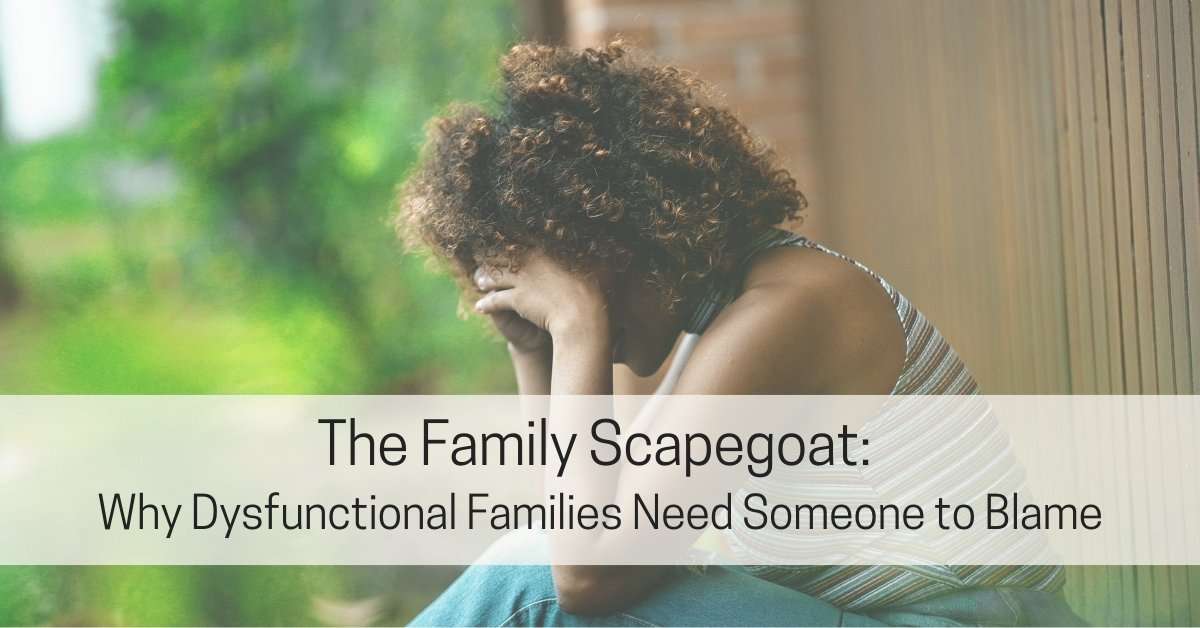
If you were the family scapegoat, you may have spent years believing you were the problem. You may have been blamed for conflict, criticized more harshly than others, or told you were difficult, dramatic, selfish, or too sensitive. These messages shape how you see yourself and your role in the family. You become the focus instead of the family dysfunction you’re reacting to.
This article examines how that role develops in dysfunctional families and why it is often assigned to the person who challenges the family narrative. It also looks at the strengths that can develop in the person placed in that role and how those strengths can help you overcome the effects of the dysfunctional system you were raised in.
Why Dysfunctional Families Need a Scapegoat
Families operate as systems, and people often fall into predictable family roles where everyone plays their assigned part to keep the family functioning as is, even when it’s not healthy or effective.
In healthier families, problems can be discussed and repaired. People take responsibility for their behavior, disagreements can be addressed, and relationships change when something isn’t working.
In dysfunctional families, honesty and accountability feel threatening because they require change. If someone acknowledges harm, the family may have to face uncomfortable emotions, long-standing patterns, or unequal power dynamics. That can causes tension because the dysfunctional family system isn’t willing to change.
These families are often organized around maintaining the status quo:
• Avoiding conflict
• Protecting family image
• Defending or excusing the “bad behavior” of certain members
• Minimizing or explaining away harm
• Enabling abuse
Scapegoating is a way for dysfunctional families to avoid addressing the real problems. It shifts attention away from the dysfunction and creates a simpler story: the conflict exists because of one person.
It also functions as a form of control. When someone is repeatedly labeled as the problem, they are pressured to “stay in line” and not challenge the system. If the scapegoat speaks out or contradicts the family narrative, they risk physical and emotional harm, public humiliation, or being cast out of the family entirely.
But scapegoating is a family dynamic, not a personality trait.
Over time, roles become reinforced. The scapegoat is expected to absorb tension, and any resistance to that role tends to be met with criticism, distancing, or blame.
This is why scapegoats are often the people who notice inconsistencies, raise concerns others avoid, question unfair treatment, or refuse to participate in denial.
The Pain of Being the Scapegoat
Being the family scapegoat is a painful experience because you’re repeatedly and intentionally misunderstood by the people closest to you. You’re blamed for things you didn’t do or couldn’t control, and your experiences are dismissed or denied by others. The result is often a persistent sense of inadequacy and a feeling of not belonging.
This affects how you show up in relationships. You may become cautious about what you say, second-guess how you are coming across, and be hypervigilant about the possibility of being blamed or misread. Trust becomes harder — not only trust in others, but trust in your own read of situations. You may fear that what you say will be turned against you or that you will end up cast as the problem again.
Feeling angry in response to this is understandable. Anger makes sense when you have been blamed for things you did not cause, when your reality has been questioned, and when you have had to defend yourself just to be taken seriously.
It is also natural to grieve what was missing — the family connection that did not feel safe or consistent, the experience of being understood, and the time spent trying to repair relationships with people set on blaming you.
The Strengths of the Scapegoat
The traits that created friction in a dysfunctional system can become strengths in healthier environments. Here are a few that you may not have recognized in yourself.
- Awareness of relationship dynamics. Scapegoats become highly attuned to emotional patterns and inconsistencies in relationships. Growing up in an environment shaped by denial or unpredictability trains you to pay close attention to what is actually happening, not just what is being said. You notice tone shifts, tension in the room, and when someone’s words don’t match their behavior. This kind of awareness helps you recognize when something in a relationship feels off, unsafe, or unfair.
- Courage. Drawing attention to family dysfunction takes courage, especially when you know you’ll be speaking up has consequences. As a result, you may be less willing to ignore behaviors that feel like red flags.
- Authenticity. Many scapegoats place a high value on honesty in relationships. After experiences where your feelings were dismissed or rewritten, you’re likely to seek relationships that value honesty and transparency; you’re not interested in “playing games” or living by unspoken rules.
Using Your Strengths to Break Generational Patterns
The point is not to spend years trying to convince your family to see things differently. Instead, use the strengths you’ve developed.
These traits can help you:
• Break generational patterns of abuse, trauma, and dysfunction. You recognize familiar dynamics, such as blame shifting and denial early, which means you’re less likely to unconsciously repeat them.
• Build healthier relationships. You choose relationships where it’s safe to disagree, and accountability goes both ways.
• Advocate for yourself. You can ask for what you need, set limits, and correct misrepresentations instead of staying silent to keep the peace.
Conclusion
The scapegoat is usually the person who sees their family dysfunction clearest. Because you’re unwilling to ignore or normalize what’s happening, you’re seen as the problem.
You’re not too sensitive or difficult; you’re simply refusing to participate in the dysfunction. Now it’s time to embrace the strengths that grew out of being the family scapegoat and use them to build something healthier outside of it.
©2026 Dr. Sharon Martin, LCSW. All rights reserved. Photos courtesy of Canva.com.
Related Articles
Your Decision-Making Blueprint
A Digital Guide for Adult Children of Toxic or Narcissistic Parents Considering Low or No Contact
- Identify abusive behaviors and toxic traits
- Reflect on if or when it makes sense for you to distance yourself from a difficult relationship
- Learn about how distance can aid healing from toxic relationships
- Feel empowered to make choices that prioritize your needs
- Practice setting boundaries that protect your physical and emotional safety
Dr. Sharon Martin

Dr. Sharon Martin is a trauma therapist supporting adult children of dysfunctional families. She’s passionate about helping adults overcome the effects of narcissistic and emotional abuse, learn to set boundaries, and develop self-worth. She writes extensively about codependency, perfectionism, and healthy relationships, including the popular blog Conquering Codependency for Psychology Today. Dr. Martin is the author of four self-help books, including The CBT Workbook for Perfectionism and The Better Boundaries Workbook.
Publisher: Source link