
Despite the growing global discourse around the revenue potential of waste to wealth — i.e., reimagining waste as a valuable resource — profitability in municipal solid waste management remains low due to high logistics costs and inefficiencies. Meanwhile, regulatory requirements and initiatives from the Indian national government to improve waste management have forced waste entrepreneurs and local governments to shore up their revenue streams to better fund their operations.
However, this approach is insufficient. With volatility in the recyclables market and almost half of all municipal solid waste having no value, according to our analysis at Waste Warriors Society, efforts to convert waste into value are unlikely to cover their own expenses, especially as new regulations like India’s Solid Waste Management Rules come into effect. Instead, user fees play a greater role in recovering collection and processing expenses.
Collecting user fees from households is the exact course of action recommended by the Solid Waste Management Rules — but this is easier said than done. In low- and middle-income countries (LMICs) such as India, many residents are reluctant to pay to dispose of something they could simply burn or dump on the side of the street. A common refrain in these parts is: “We have very little waste, just a little plastic that we burn occasionally.” In these regions, changing people’s behaviour by convincing them to pay user fees and sort their waste properly remains a major challenge.
Waste Warriors Society has taken on this challenge in the Indian Himalayan region and lived to tell the tale — but not without battle scars. As a non-profit that prioritizes systems change, we build and manage waste collection systems with the aim of gradually handing them over to the community, to be run by local entrepreneurs or service providers. For the long-term sustainability of these systems, it is imperative to have a steady revenue stream from user fee payments. Through a combination of awareness campaigns, cleanup drives, stakeholder engagement and the provision of reliable services, our non-profit has managed to onboard and retain thousands of paying customers for our programs, involving the collection, segregation, processing and recycling of municipal solid waste at nine locations across the region.
Customer churn, though, is inexorable and hard to understand. When we started out, we suffered our fair share of dropouts. Sometimes these happened across an entire village over only a few months. In other cases, we observed individual dropouts at locations where other households persisted, even without any change in the quality of service delivery or other differences between households. We realized that we needed to better understand the individual motivations for paying user fees, so we could prioritize our next steps to keep the balance sheet in the black.
To enhance our understanding of our customer base, we analyzed user fee records between April 2024 and October 2025, from 850 households across six villages near Dharamshala, in the mountainous state of Himachal Pradesh. We compared these payment records with survey responses obtained through interviews with both loyal and churned customers, aiming to learn the reasons behind their respective choices. Using the theory of planned behaviour framework to interpret our observations, we identified key takeaways for retaining paying customers, which can inform municipal solid waste management and other user fee-based models of social entrepreneurship.
Leaders and Community Members can Elevate or Diminish Participation
Across the six villages we studied, we found fairly similar customer attrition rates; where rates differed, a key explanation was the influence of leadership and community norms. As anticipated, a similar, small attrition rate was experienced in most wards over the 18-month period. One exception was in Barwala, a village with relatively lower income levels, where we charged 60% of our standard user fee. From six months to a year after onboarding, the attrition rate in Barwala was much more pronounced.
One potential explanation for the steeper decline in customer engagement in Barwala was local opposition to our planned material recovery facility (MRF), which we proposed as a way to reduce collection and transportation costs for servicing this remote village. Local leaders mistook the planned facility for a dumpsite and actively discouraged households from participating in the waste management program. Despite this initial setback, Waste Warriors saw this as an opportunity to better explain our waste management services to the community. In response, we cancelled plans for the MRF, encouraged leaders to visit one of our existing well-maintained MRFs, and hired interns to lead community engagement campaigns. These campaigns spread awareness about the services, encouraging households to visit our MRFs at other locations and rejoin the waste management program. Slowly, these awareness campaigns led to a substantive recovery of enrolment in the waste management program in Barwala.
Figure 1. Effects of social norms on user fee payment trends. Percentage of users that paid user fees in each month from April 2024 to September 2025 in the Barwala Panchayat. Each line represents a ward.
In another village, Narwana Khas, a few miles east of Barwala, we noticed two wards where the participation rates were distinct from the five other wards in the village, showing somewhat more willingness to pay (see Figure 2 below). We learned that these wards are populated primarily by the Gaddi community, a close-knit ethnic group traditionally involved in nomadic grazing. Our interpretation is that some key community members participated in our services, leading to strong uptake through the rest of this community. As these observations demonstrate, social norms can influence participation in waste management programs top-down through leaders or by spreading through homogeneous communities.
Figure 2. Effects of group norms on user fee payment trends. Percentage of users that paid user fees in each month from April 2024 to September 2025 in the Narwana Khas Panchayat. Each line represents a ward.
Satisfaction with Collection Services is Key to Retaining Customers
While community-level norms and leadership explained some differences between wards, we also noticed variability between neighbouring households. To understand these differences, we compared survey responses from retained customers (>90% of months paid after onboarding) with those from churned customers (<75% of months paid).
Retained customers tended to be more satisfied with the service provider’s reliability and communications. More specifically, these customers felt they could submit complaints to service providers and receive prompt redressal. Some even developed a strong enough bond that they began offering tea to waste collectors during their runs. These findings show that reliable and high-quality service, personal relationships and confidence in grievance redressal are important to customers and contribute to customer retention.
Figure 3. Attitudes towards the service managers. Percentage of users among Sustained Participants, Intermittent Participants and Discontinued Households that responded “Yes”, “Sometimes” or “No” to whether the “Supervisor promptly resolves complaints.”
Insufficient Participation and Lack of Visible Cleanliness Outcomes Cause Customer Churn
Another challenge we noticed was a collective action problem. A common complaint raised by churned customers in unstructured interviews was that their immediate surroundings remained littered with waste, despite their participation in the collection program. Since they felt their fee contribution did not noticeably improve cleanliness outcomes in their neighbourhood, they stopped participating in waste collection. Some participants said they would not pay user fees until their neighbourhood was cleared of legacy waste, and care was taken to ensure that it would not become a dumping ground again. As one respondent, a retired army veteran, said, “I have made it clear to the person who comes to collect user fees: Until you stop people from dumping their waste in the field next to my house, I will not pay. It causes mosquitoes and a foul smell.”
Yet unfortunately, even when the program ran successfully, a few non-participants continued littering. Residents complained that, without full participation from the community, open dumping by non-participants in the program would continue. Multiple churned customers relayed some variant of: “We used to support your services, but one person can’t make a difference. Ask everyone to join, then we will also join.”
On the plus side, many former users remained open to returning to the program if community uptake were greater: We asked five churned customers if they would resume paying user fees if everybody in their neighbourhood participated, and they all responded yes.
Personal, Social and Outcome Perceptions Drive Household Participation
Development practitioners often attribute the lack of onboarding into environment-friendly programs to a lack of awareness. Business models for sustainability initiatives are typically designed around value propositions, and these programs may view complex behavioural changes through the simplistic lens of customer uptake, leading them to focus solely on service delivery or advertising. In reality, individuals are making choices based on multiple factors: Therefore, practitioners must adopt a wider lens that addresses the structural and social elements of this complex behaviour.
The theory of planned behaviour framework suggests that behaviours are determined by intentions, which in turn depend on attitudes, subjective norms and perceived behavioural control. Our analysis suggests that all three of these components influence customers’ likelihood to pay user fees for waste management services.
- Attitudes: Retained customers’ attitudes toward waste collection services tend to be positive, with high satisfaction around the grievance redressal process.
- Subjective Norms: Overall payment rates in villages drop when local leaders, whose opinions drive social norms, discourage participation. At the same time, community engagement campaigns that encourage people to take care of their environment can influence norms and improve participation. Similarly, social norms around whether the collective neighbourhood would participate in waste collection influenced individual participation rates, and shaped customers’ opinions of whether their efforts would be worthwhile.
- Perceived Behavioural Control: When individuals feel a behaviour change is easy and can influence outcomes, they are more likely to make that change. As mentioned above, in our interviews, churned customers frequently cited the lack of improvement in neighbourhood cleanliness as a reason for not participating.
Strategic Interventions for Sustaining Community Participation
Analysis from this 18-month study has informed our action plan to continue iterating on our systems. We plan to focus on the following elements to increase community participation, reduce churn and improve user fee collection:
- Maintain service quality to keep customers: When waste collection becomes irregular (e.g., in inclement weather or during the transition period when operations are handed over to local entrepreneurs or service providers), user fee payments often drop. Maintaining service quality is vital to retaining customers.
- Leverage social norms to improve participation: Social norms operate through multiple routes. Engaging with community leaders can have positive multiplier effects. Awareness campaigns appealing to morality can also help. Ultimately though, people tend to swim with the tide. When the majority is seen to be participating, it reinforces sustained participation and prevents churn.
- Ensure visible cleanliness outcomes: Waste collection service providers typically restrict themselves to collecting and processing waste. However, understanding customer expectations regarding outcomes from the service is important to preventing customer churn. In this case, that would mean allocating resources towards cleaning and monitoring neighbourhoods.
Leveraging Behavioural Science for a Holistic Approach
Governments and businesses often talk about the importance of increasing the ease of doing business and removing regulatory barriers to encourage investment and promote entrepreneurship. However, in sectors like waste management, where operations depend on consistent user fee payments, the more immediate priority is to create the right conditions for individuals to participate. Predictable revenues make for more attractive investments.
Humans, as complex beings, make choices through a combination of personal and social beliefs. For that reason, we have focused on engaging people’s attitudes, subjective norms and perceived behavioural control to sustain behaviour change. Providing easy-to-use services and maintaining quality are central to our approach. Yet high-quality service can only go so far when the initial conditions (i.e., legacy waste) and the need for continued monitoring go unaddressed. Raising community awareness of programs and addressing concerns can facilitate uptake and retention. But even if they do everything right, well-intentioned programs may fail if they do not engage key members of the community or showcase membership to induce further participation. Hopefully, industry practice and behavioural science can come together to allow consistent progress in this sector.
Towards that end, we are currently collaborating with academics and behavioural science practitioners to design pilots where we integrate our learnings from this analysis. These programs could involve cleaning up legacy waste and setting up neighbourhood monitoring programs to prevent littering, among other potential approaches. Additionally, these pilots will aim to engage community leaders early in their outreach campaigns and post visible markers of participation, to help promote changes in social norms around waste management.
Integrating such approaches with a continued focus on service quality could yield improvements in user fee payments across households and make waste management financially sustainable in rural communities — not only in India, but across other LMICs.
Vishwanath Varma is a researcher with a background in social and collective behaviour; Archana Masih works in communications at Waste Warriors Society; Diksha Rana is a Research Consultant at Waste Warriors Society; Ashish Kapil leads the Monitoring & Evaluation initiatives at Waste Warriors Society.
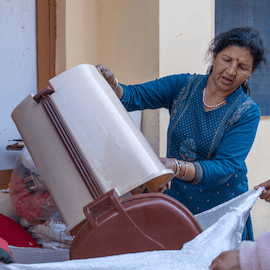
Photo: A resident emptying their trash during collection. Credit: Waste Warriors Society
Publisher: Source link