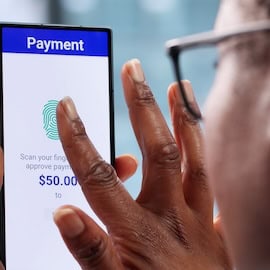
In emerging economies, the lack of disposable income often hinders economic growth. Evenly distributing a local means of exchange can directly tackle this issue, especially when its supply and governance are democratic and transparent.
The Encointer Association, a Swiss-based nonprofit, has spent the past seven years developing such an approach. The Association’s blockchain-based community currency system started as a pilot in Zurich, and it is built within the Kusama ecosystem — a decentralized blockchain network that provides the secure infrastructure on which Encointer (and other systems) operate, powered by its native cryptocurrency token KSM. The successful pilot demonstrated how this system can enable communities anywhere in the world to create and manage their own local currency.
While Malik was developing this system at Encointer, Alinagwe was building the Jukumu NGO to foster economic connections within the Mburahati community in Tanzania. The organization brings entrepreneurs and other professionals together to strengthen local economies: for example, by helping farmers sell their produce and supporting local businesses.
The two of us connected through mutual friends after the Polkadot Safari conference in Nairobi, Kenya, in the spring of 2023. Shortly thereafter, we began exploring how Encointer could be adapted to the Tanzanian context, and in September 2023, alongside our partner Chatafisha, we launched the Nyota community currency in Dar es Salaam using Encointer’s protocol.
Each of the three partners behind the Nyota local currency system contributed distinct expertise. Encointer brought its blockchain expertise and transparency-driven principles, Jukumu leveraged the solidarity and trust it has earned in the local community, and Chatafisha brought its experience developing digital tools for marginalized communities, from waste pickers to savings groups. Together, we localized Encointer’s model, launching Nyota as a payment system for local goods and services. Within months, participation grew to almost 100 individuals and several businesses across various sectors.
Below, we’ll explore how this local currency system works, and how similar systems can be developed to support economic growth in other communities across emerging markets.
A Model Rooted in the Concept of Universal Basic Income
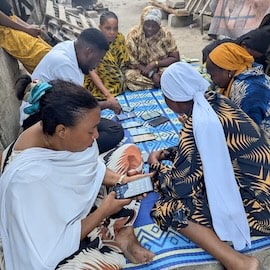
Unlike traditional monetary systems, which rely on credit and interest, Encointer’s model is built around grassroots economic coordination and community-driven currency creation. It includes universal basic income–like mechanisms that provide regular local currency issuance to participants. The system distributes this local currency through in-person attestations based on physical presence and mutual verification rather than official documents. This process ensures each participant’s uniqueness and allows people without formal IDs or bank access to participate on equal terms.
Everyone in the local community is invited to participate in these gatherings, which take place every 10 days. For each verified participation, individuals receive 5 Nyota, the name of the digital local currency. Within the community, 1 Nyota is informally valued at 1,000 Tanzanian shillings, making the reward equivalent to 5,000 shillings (about $2). For some participants, this represents close to a day’s basic budget.
In addition to the issuance of the local currency, a digital faucet (i.e., an automated token dispenser) distributes a small crypto allowance of 0.1 KSM (approximately $0.50) per gathering and participant. This operates as a small, traceable cash transfer delivered through a combination of blockchain and mobile infrastructure. While the Nyota currency is intended to primarily circulate within the community, with restrictions on whether/when it can be exchanged for Tanzanian shillings, this additional allocation of Kusama crypto tokens can be easily exchanged for shillings, for example to cover mobile data costs or other external expenses.
Through these currencies and the system that enables them, the Encointer model offers a new instrument to traceably stimulate local economic development, with potential applications in both international and domestic development programs.
Fractional Reserve and Democratic Liquidity
The Nyota initiative shows how this approach can be applied in local communities. We established the Nyota community currency as a payment alternative for locally produced goods and services. The value of this currency is rooted primarily in trust within the community, based on its acceptance by local vendors for everyday transactions. In addition, it is supported by a community reserve that was initially filled through a cash injection that came from grants awarded to the Encointer Association, including funding from the Web3 Foundation and the Kusama ecosystem. Within Kusama, grants are distributed via an on-chain treasury (a transparent, blockchain-governed funding pool in which participants publicly submit, evaluate and vote on proposals).
The community reserve acts as a fractional reserve, meaning it backs only a portion of the value of the cryptocurrency circulating in the local economy, not every unit one-to-one. Similar to the gold standard, the reserve provides a credible anchor that strengthens trust in the currency.
In practice, the reserve addresses a common sustainability challenge of community currencies: Popular businesses that accept large amounts of local tokens often accumulate more than they can meaningfully spend within the community. By allowing these businesses to convert a limited share of their holdings into national currency, the system prevents imbalances and ensures that key participants remain engaged.
Figure 1: Illustration of faucet drips, community currency minting, and the democratically governed community reserve acting as a fractional reserve mechanism.
Because the reserve only needs to cover a fraction of the circulating value, the volume of local currency transactions can exceed the amount of external funding injected into the system. In other words, each dollar placed in the reserve enables several dollars’ worth of local exchange, as the community currency circulates repeatedly among participants before any conversion to fiat currency occurs. Access to these conversions (called swap options) is granted through proposals and community votings. Currently, approved swap option proposals enable members to convert Nyota into USDC, a U.S. dollar–pegged stablecoin, directly within the Encointer app. The USDC can then be transferred and exchanged into Tanzanian shillings. Integrations with Visa cards and with digital national currency systems are planned, which would simplify the process and lower barriers to access.
This approach aligns with the principle of subsidiary democracy, empowering communities to shape their own economies from the bottom up. Leveraging mobile and blockchain technologies, it ensures accessibility and transparency without relying on state or corporate infrastructure.
Expanding the Model Through Local Partnerships
Over time, we expanded this model. Jukumu organized businesses addressing similar basic needs, such as tailors, food vendors or sellers of hygiene products, into sector-based groups. Within these groups, members develop joint projects (for example, tailors coordinating their clothing production or food vendors participating in bulk purchasing of ingredients), and they can apply collectively for small loans from the community reserve to cover these costs. Access to these loans requires a viable joint project and sufficient local currency (Nyota) held collectively by group members as collateral. This strengthens cooperation within sectors while reinforcing the circulation of the community currency.
To help accelerate adoption, we worked with community leaders to leverage local informal savings groups, integrating the Encointer system with the traditional Mchezo: a rotating savings and credit system deeply rooted in Tanzanian culture. Combining the Mchezo model with Encointer’s Kusama-based digital faucet resulted in the Kusama Mchezo, one of the world’s first blockchain-enhanced savings circles.
In the first round of lending in this savings circle, participants pooled their crypto allowances, exchanged them for Tanzanian shillings, and used the funds to start or expand small enterprises. Within months, 15 new ventures emerged, including tailors, cooks and artisans. Many are still operating today, even as the Kusama Mchezo has moved into its third round of lending, demonstrating the initiative’s effectiveness in injecting liquidity, building trust and fostering entrepreneurship.
Blockchain as Public Infrastructure: A New Instrument for Effective Development Aid
These successes relied on key contributions from each of the partners in the Nyota initiative. Chatafisha played an important role in setting up the project, but has been less involved in its ongoing operations. The partnership with Jukumu has enabled local innovation to flourish: The NGO has become the social backbone of the Nyota community in Dar es Salaam. It mobilizes entrepreneurs and savings groups, builds trust through training and community work, and adapts the system to local economic practices and cultural norms. Jukumu coordinates day-to-day operations, gathers feedback and evaluates impact, ensuring that Nyota remains locally governed, socially embedded and responsive to community needs. One of its earliest ideas, a partial buy-back program, allows members to exchange a portion of their community currency back into Tanzanian shillings. This mechanism has not only provided liquidity, it also became the conceptual seed for what would later evolve into Encointer’s fractional reserve model.
The Encointer Association, by contrast, does not operate local projects. Its role is infrastructural: It develops and maintains the open-source technology that allows communities like Nyota to issue and govern their own currencies, provides the digital wallet and governance mechanisms, and offers technical guidance.
While Encointer is built on blockchain technology, cryptocurrency is not used as a speculative asset in initiatives like Nyota. Instead, it functions as a public digital infrastructure that enables coordination without relying on banks, governments or private platforms. This infrastructure, by utilizing an open source code base, makes it possible for communities to govern their own currencies, reserves and participation rules transparently and collectively.
This infrastructure enables three things:
- Community self-governance: Participation rights are linked to in-person gatherings, where participants attest that other participants are unique individuals with their own accounts. These attestations grant participants the right to mint the local community currency and to participate in collective decision making, including votes on how the community reserve is used. For example, decisions on which activities are supported, or who can exchange local currency back into national currency, are made collectively.
- Inclusion without formal IDs: Because participation is based on physical presence and mutual attestation rather than official documents, the system remains accessible to people who lack formal identification or access to banking services. Verification does not rely on a central authority; instead, it is performed collectively by participants themselves, with everyone operating on the same level.
- Lower costs and higher local impact: Compared to traditional aid transfers, blockchain-based value transfers can significantly reduce transaction costs. More importantly, within the Encointer system, funds are not simply spent once. Instead, they become part of a locally governed economic cycle that keeps value circulating within the community and amplifies its impact.
The system is more than a simple cash transfer mechanism; it establishes a local currency and a democratically governed reserve, enabled by regular community gatherings that form the basis for trust, coordination and collective decision-making.
The Nyota Community: A Model for Local Currencies in Africa
Today, Nyota counts more than 100 participants, and it has funded 60 active entrepreneurs organized in seven business groups.
At its heart is Chairwoman Jackline Sobo, who hosts regular gatherings in her home. Known for her roasted cashew nuts and braiding skills, she says: “Through Nyota, many people have come to know my work. We support each other. When I buy from them, they also buy from me. It makes us grow together.”
Stories like Jackline’s reveal how Nyota has become a self-reinforcing local economy, blending technology, trust and human creativity. They also hint at the impact that could be achieved if the Nyota model is applied elsewhere in Africa.
Since 2023, Encointer has worked with other communities to explore their interest in launching their own crypto-based local currencies. Inspired by the Nyota community’s success in Dar es Salaam, the community of Zaria, Nigeria has worked with the Encointer team to launch a new local cryptocurrency initiative with a solar-powered IT setup. To enable this, the local team repurposed an old HP computer as a blockchain node, showing that technical decentralization does not require costly infrastructure. Their node now helps secure their local currency and, at the same time, strengthens the global security of the underlying Kusama Network, helping to balance Africa’s underrepresentation among blockchain validators.
However, the motivation driving this new community is about more than running infrastructure for a global network. Like the Nyota project and other blockchain-based local currencies, it is about bringing prosperity to the individuals and businesses across Africa and other emerging markets that have been excluded from access to capital for far too long.
Malik El Bay is the operational lead of the Encointer Association; Alinagwe Mwaselela is the Team Lead of the Nyota Community and the founder of Jukumu NGO in Dar es Salaam.
Photo credit: Alinagwe Mwaselela
Publisher: Source link