
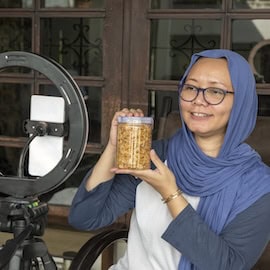
Across emerging markets, millions of women entrepreneurs operate in trust-based economies invisible to formal finance. From street food vendors in Kenya to home-based traders in Bangladesh, these businesses rely on their social reputation — customer networks and relationships built through reliability and consistency — to survive.
In Indonesia, these trust-based enterprises are common, and MicroSave Consulting (MSC) assessed their experiences, challenges, and usage of credit and other financial services in our recent report “The Landscape and Financial Access of Social Commerce Sellers in Indonesia.” The study draws on survey data and qualitative interviews with 458 sellers across seven provinces, offering grounded insights into how informal women micro-entrepreneurs operate and access finance in practice.
This article shares quantitative analysis and in-depth interviews from the report to examine the platform journeys, business practices and financing gaps of social commerce sellers, with a special focus on women sellers.
Empowering Trust-Based MSMEs: Government efforts vs. lived realities
One of the entrepreneurs we interviewed is Suryani, a 45-year-old mother of two from Balikpapan. She supports her family by reselling children’s toys and selling homemade snacks. But though she has been engaged in this business activity for decades, her business remains unregistered, and her only experience with formal credit has been through a cooperative.
Suryani does not sell her products on formal e-commerce platforms. She relies on Facebook and WhatsApp to reach customers within her community, a form of social commerce that remains largely invisible to formal credit systems. Her experience mirrors that of millions of Indonesian women micro-entrepreneurs, who are widely recognized in policy rhetoric yet whose operating conditions and constraints are not fully reflected in existing policy design.
Indonesia’s commitment to the empowerment of micro, small and medium enterprises (MSMEs) has been impressive. Recognizing that the country’s 65.5 million MSMEs are the backbone of its economy, the government has deployed a wide range of policies, financing schemes and public–private partnerships to expand their access to credit and markets. Flagship initiatives, such as the Kredit Usaha Rakyat (People’s Business Credit) and Ultra-Micro Financing programs, have sought to empower entrepreneurs, particularly women, by boosting their access to finance. More recently, in June 2025, the Ministry of MSMEs and the Ministry of Women Empowerment and Child Protection launched the Laksmi incubation program for women entrepreneurs, which combines capacity building with supervised financing. But though Indonesia’s MSME support ecosystem appears advanced and enabling on paper, in practice, this architecture is built primarily around formal business, as the eligibility criteria for these programs create barriers for those operating outside traditional structures.
Meanwhile, for entrepreneurs like Suryani, who have operated informally for over a decade, the reluctance to seek formal credit persists. MSC’s study on social commerce sellers in Indonesia helps quantify this dynamic: Only 15% of these sellers have accessed formal credit, and just 18% hold a business identification number. Most of these entrepreneurs operate on WhatsApp, Facebook or Instagram, rather than formal e-commerce platforms.
This pattern reflects not a lack of a growth mindset, but the constraints under which many informal businesses operate. Rather than pursuing rapid expansion, many prioritize predictable cash flow, manageable exposure and stable customer relationships, particularly in contexts where repayment risk is salient. As one seller put it, “I prefer what is certain.” For these entrepreneurs, formality, both in financing and in their broader business structure, does not guarantee stability — on the contrary, it can disrupt the trust-based systems that sustain their livelihoods.
In terms of credit, these concerns are driven not by an inherent distrust of formal finance among women micro-entrepreneurs, but rather by the fact that existing loan products are not well-aligned with how they often operate in practice. Many of these sellers work in fast-moving or seasonal consumer segments with fluctuating input costs and irregular cash flows — while also juggling significant household care obligations. Yet formal loans tend to assume stable cash flows and fixed repayments, while few products are designed around the realities of informal women-run businesses. Additionally, this borrowing often takes place through community-based channels such as microfinance institutions and cooperatives operating group-based (Grameen-style) models, where repayment outcomes are highly visible. As a result, a single default can erode credibility, sever customer ties and dismantle fragile safety nets. Formalization and credit thus become double-edged swords, promising growth while threatening the continuity these businesses have worked hard to preserve. In a trust-driven ecosystem, reputation is considered both an asset and a liability, so for these women entrepreneurs, informality is not resistance to growth: It is a strategy for stability.
In Suryani’s case, her first experience with an informal lender intensified her wariness toward credit providers. Her loan culminated in the loss of her warung (a small, informal, family-run retail or food stall that operates at the neighborhood level), and triggered gossip about her loan within her community, shaping perceptions of her repayment reliability, business competence and standing as a community member. This raised the perceived cost of borrowing and reinforced her decision to avoid further loans.
Drawing on our recent study, 74% of social commerce sellers rely solely on personal savings — a pattern that is seen among other small enterprises across the nation. Their avoidance of credit, despite this clear need, shows that many of these entrepreneurs consider self-funding to be a pragmatic response to the trade-off between stability and risk that loans represent.
When trust meets risk management and the gender gap
By contrast, the formal financial system is governed by a different logic — one centered on risk management. Banks lend only when risk is documented, verified and priced. Yet this risk-averse approach often clashes with the lived realities of women entrepreneurs whose informal businesses thrive on relationships, reliability and trust.
Banks in Indonesia are lending large volumes to MSMEs: Last year, the government injected Rp 200 trillion (~US 11.9 billion) of state funds from Bank Indonesia into five state-owned banks to accelerate MSME financing. By July 2025, the People Business Credit program had expanded to IDR 300 trillion (~ US 17.9 billion), with IDR 131.84 trillion (~ US 7.8 billion) or about 46% disbursed in the first six months. Yet this lending has largely been directed toward formal MSMEs that already meet banks’ underwriting requirements, such as having business registration, financial records and clear operating structures. And even for these MSMEs, results remain uneven: Financial system statistics recorded an MSME non-performing loan (NPL) ratio of 4.14%, already approaching the Indonesia Financial Service Authority’s 5% supervisory risk threshold. Since banks operate under ongoing pressure to maintain NPL ratios and portfolio quality, they have limited ability to extend similar risk tolerance to informal entrepreneurs whose performance is not as easily documented through conventional indicators.
The core issue, therefore, is not that banks refuse to lend, nor that MSMEs irrationally avoid loans. The issue is a structural mismatch between prudential, document-based banking logic and trust-based, informal business models.
Banks, nonetheless, remain the most trusted financial institutions among MSMEs. Among the surveyed sellers in MSC’s study, we found that 73% of male and 69% of female borrowers prefer banks to pawnshops, leasing firms or cooperatives. Yet this trust is rooted in perceived legitimacy more than real accessibility. In this space between expectation and experience, the double-edged nature of formal finance becomes apparent: When banks’ risk-based logic meets entrepreneurs’ informal realities, exclusion can become systemic.
This exclusion is not just operational, it is also gendered. Women-owned MSMEs in Indonesia and other developing economies typically receive smaller loans and face stricter collateral requirements. And they often must secure spousal consent, creating structural filters that reinforce financial dependency on household decision-makers — most often spouses — and limit women’s financial autonomy. Even when women entrepreneurs show reliability through their digital footprints, such as steady social commerce sales, repeat customers and positive testimonials, these signals remain invisible to traditional credit models. As a result, lenders rely on narrower indicators such as collateral and formal documentation, pushing women entrepreneurs toward smaller, informal or higher-cost financing, and shifting risk back onto borrowers whose reliability is demonstrated through relationships and reputation.
From trust to creditworthiness: Moving toward gender-intelligent and inclusive lending
Since banks and micro-entrepreneurs such as Suryani rely on different signals to establish trust and creditworthiness, gender-intelligent lending must serve as a translation layer between them. Without such an approach, existing financial design risks reinforcing exclusion by overlooking how women actually participate in and sustain economic activity. Research on platform livelihoods helps explain this gap, showing that for many women entrepreneurs, social media functions as core business infrastructure, where responsiveness, social relationships and community reputation shape daily operations. These are therefore not “soft” data, but measurable indicators of credibility and reliability grounded in lived practice.
Alternative credit scoring provides a structured way to incorporate behavioral and transactional data into formal risk assessment where conventional documentation is limited. In practice, these alternative credit scoring approaches are typically AI-enabled, using automated models to process non-traditional data sources. CGAP’s work on gender-intentional credit scoring shows that incorporating gender-relevant behavioral indicators can improve the accuracy and relevance of credit assessment for women entrepreneurs by aligning lending models more closely with observed repayment behavior — including data points that are often not reflected in existing credit assessment standards — without weakening existing prudential standards. As the Asian Development Bank cautions, the use of AI-driven and other automated credit assessment systems must be intentionally designed and governed to avoid reinforcing existing gender bias. But when applied with transparency, bias monitoring and human oversight, these approaches can complement prudential assessment by taking women-led MSMEs’ reliability into account, instead of simply redefining risk to avoid excluding them.
In line with this evolving understanding of risk and creditworthiness, our study examines how granular behavioral and transactional data can strengthen credit assessment for women micro-entrepreneurs in social commerce, as summarized in the table below:
Table 1. Predictive behavioral data points for assessing the creditworthiness of women entrepreneurs in social commerce
Across the nine indicators identified, we observe that the signals most relevant to women sellers can complement rather than substitute for traditional evaluations. These indicators capture how enterprises are sustained in everyday practice, including communication responsiveness, transaction consistency, digital payment usage and customer feedback. Together, they reflect operational commitment, sales stability and business reputation, offering observable signals of reliability and discipline that extend beyond formal identifiers such as business registration certificates or documented transaction histories. Viewed through a gender lens, these behavior-based signals can inform lenders’ assessments of entrepreneurs’ reliability and discipline, illustrating how trust is practiced in women-led enterprises.
The integration of these data points could allow lenders to develop a more complete picture of their potential borrowers. Based on these assessments, financial institutions can move beyond rigid templates to design products grounded in women’s lived realities, with the potential to broaden access while remaining consistent with banks’ existing credit assessment requirements, including documentation, verification and internal risk controls.
However, our platform analysis also reveals a structural visibility gap, whereby businesses that rely more on private messaging and informal practices leave fewer observable trust signals. This limits data-driven inclusion — unless social commerce platforms and financial institutions collaborate. Where platform data is incomplete, self-reported business information may temporarily improve visibility, but it cannot replace verified transaction data or platform-level integration.
Together, these findings point to an opportunity for collaboration between digital platforms, alternative credit scoring providers and financial institutions, where each actor contributes a distinct function. Platforms would capture behavioral footprints that reflect how women transact and build trust, alternative credit scoring providers would interpret these signals into risk insights, and financial institutions would apply them within credit products and prudential frameworks.
AI could improve the efficiency of these efforts and enable further innovation, but its outcomes would depend on the underlying data and design choices. When trained on incomplete data or data biased toward formal businesses, AI algorithms can reproduce existing exclusions by disadvantaging borrowers whose businesses operate outside formal systems. Bias detection, transparency and human oversight are therefore essential to ensure that efficiency gains do not translate into exclusion, and that inclusion is embedded within the rigor of risk management.
From risk management to shared value
When used responsibly, AI-enabled alternative credit scoring can expand the range of data considered within prudential credit assessment. For banks, this means expanding their underwriting framework. For digital platforms, it means transforming their MSME users’ behavioral data into a source of shared value, rather than simply using it for their own proprietary advantage. For policymakers, it means enabling data-sharing frameworks that protect users while fostering inclusion. And for women entrepreneurs like Suryani, it means being recognized as credible economic actors whose trustworthiness has long been established, even as it has remained invisible to traditional lenders.
Financial inclusion is not about relaxing risk management. It is about redefining evidence through data points that reflect the lived realities of informal women micro-entrepreneurs. If inclusion is treated as a deliberate design choice, financial systems can improve the accuracy and relevance of risk assessment without compromising prudential discipline, building an economic infrastructure that supports the business continuity, resilience and reliable operations of informal micro-enterprises.
Nabilla Prita Fiandini is an Assistant Manager, and Monica Christy is the Senior Manager for Gender Equality, Disability and Social Inclusion, at MSC Southeast Asia.
Photo credit: leolintang
Publisher: Source link