Across Africa, something subtle yet profound is changing in how global development-focused organizations communicate about their work and impact. The traditional approach to development communications, often shaped by donor frameworks, log frames and visibility requirements, tends to prioritize outputs over outcomes. Communications teams are frequently tasked with producing reports, campaigns and visibility materials that satisfy compliance needs, but don’t always reflect the lived realities of communities, frontline implementers or local partners. As a result, storytelling can become disconnected from how change actually unfolds on the ground.
What’s more, this messaging often comes via outside comms professionals working on a contract basis, as African organizations have long been operating in what could be called the “consultant era” of development communications. In my experience working with African development organizations and international partners, this has often meant relying on external communications consultants who produce recommendations, or design strategies and messaging frameworks, then exit before those plans are fully implemented.
These are all valuable priorities, but they are frequently detached from the impacts and activities that embody an organization’s mission — and the deeper narrative it wants to share about its work.
That consultant-led model, while once sufficient, no longer fits the pace and complexity of Africa’s evolving development ecosystem, leading a growing number of organizations to seek greater ownership of their communications processes. This mirrors a similar shift that is happening in the private sector, where African companies are increasingly moving away from one-off advisory engagements toward models that prioritize hands-on execution and long-term operational involvement.
When storytelling is limited to impact reports
I’ve spent over ten years working in development communications across agriculture, energy access, gender inclusion and entrepreneurship programs in East Africa, supporting organizations funded by major donor institutions.
I have often encountered African development organizations with excellent communications strategies that never make it beyond PowerPoint. Their teams are doing remarkable work, but their results rarely travel beyond a project’s impact reports.
It is not for lack of commitment. Most of the time, it’s a matter of structure and priority. Communications is still too often seen as “nice to have” but not integral to the broader mission — something to handle once the technical work is done, often to fulfill a requirement to meet donor visibility standards.
But when storytelling remains an afterthought, the cost is huge. Communities lose ownership of narratives that concern them. Funders struggle to see how change actually happens on the ground. And organizations miss the chance to shape how Africa’s progress is perceived globally.
When externally developed communications plans don’t extend into execution — when they end at “recommendations” or a one-off report — their potential to strengthen trust, mobilize support and sustain engagement is lost.
Why shifts in development funding are changing the communications game
The context around communications work in the development sector is changing fast. Traditional aid funding is contracting as global crises multiply and donor priorities shift.
As these traditional aid models decline, there’s a growing need for impact investors, corporate foundations and philanthropic ventures to ramp up their support of initiatives that can deliver both social and financial returns. According to the OECD, official development assistance was declining even before last year’s dramatic cuts. Meanwhile, impact investing continues to grow, with the Global Impact Investing Network estimating that the market reached over $1.5 trillion in global assets under management in 2024, after experiencing 21% compound annual growth since 2019.
These new actors are not looking for visibility plans or quarterly bulletins — they’re looking for evidence and engagement. They want to see how an idea becomes a movement, how capital translates into community resilience, and how stories of change connect to measurable outcomes.
In this environment, communications cannot remain a support function. It has to become an engine of accountability and learning — a system that connects data with narrative, outcomes with ownership.
For example, instead of producing glossy end-of-project videos, communications teams could create storytelling frameworks that feed directly into program monitoring and evaluation cycles. Instead of treating social media as a broadcast tool, organizations could use it for participatory storytelling, where beneficiaries and partners co-create the message.
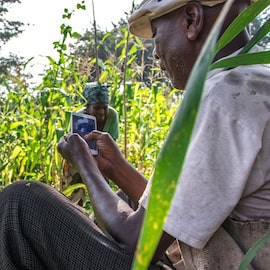
I’ve seen this approach work in smallholder agriculture projects in western Kenya, where field officers used WhatsApp voice notes and short videos from farmers to inform adaptive programming and donor learning sessions, rather than waiting for end-of-project reports.
This sort of holistic, systems-based model aligns with broader changes that are reshaping how the development sector approaches its work. Funders are not just supporting projects anymore; they are investing in ecosystems. That means every actor (funder, implementer and storyteller) must align around shared transparency and collective impact.
Learning from the “Operator-Led Model”
In a recent LinkedIn post, business strategist John Kourkoutas described how companies entering African markets are abandoning the old consultant-led model, where a firm produces a market report and steps away.
The new model, he argued, is operator-led:
“I don’t write 80-page reports. I find the distributor, structure the deal, manage shipments, and stay until it works.”
That simple statement carries profound implications for development communications.
For too long, communicators have been positioned as external advisors producing campaigns, visibility plans or messaging templates. What if instead, we became operators embedded in projects, co-owning outcomes, and ensuring that communication itself becomes a driver of change?
That would mean:
- Designing communication systems that local teams can sustain beyond donor cycles.
- Embedding storytelling into program delivery, not just program documentation.
- Measuring success not by the number of outputs created, but by how well those outputs translate into trust, behavior change or policy uptake.
When communicators stay engaged through the full project cycle, they become part of the system that makes results visible, verifiable and scalable.
Connecting data and humanity
This new approach to development communications can help organizations better leverage the data their teams are producing. Data remains essential for development, but without context, it risks becoming impersonal. That’s where communications can play a vital role: turning data into human understanding.
Many development communications teams already combine data with human stories. But too often, this storytelling happens only after programs conclude, and it’s typically focused on the limited goal of highlighting success stories and promoting program impacts. Imagine if instead, communications teams were empowered to embed storytelling throughout program implementation, informing learning, adaptation and decision-making in real time, not just packaging results for external audiences.
Storytelling is often treated as secondary to technical work, but in fact, it’s strategic infrastructure. It bridges monitoring and learning, strengthens transparency, and deepens engagement between organizations and their stakeholders.
At its best, communications acts as a mirror as much as a megaphone. It allows organizations to reflect on what’s working, surface blind spots and adapt their approaches, while also helping external audiences understand impact beyond metrics.
Building local capacity is the real long game
However, for this shift to truly take hold in Africa’s development sector, localization will be key. Many African organizations are still heavily dependent on external communications consultants or agencies. While this brings professional polish, it can also create dependency.
If storytelling capacity isn’t developed internally, narratives fade once the project closes or funding ends. To break that cycle, communications must be viewed as a local asset, not an outsourced service.
That means investing in African communicators, creatives and digital storytellers who understand cultural nuance, local languages and regional dynamics. It also means developing internal training and systems so that every program officer, field agent or community mobilizer can contribute to the storytelling process.
Localization of storytelling isn’t just good ethics, it’s good economics. It keeps the story alive, authentic and rooted where impact actually happens.
Communications as a lever for systemic change
As donors and investors demand stronger accountability and locally led approaches, communications professionals are uniquely positioned to connect policy to practice. We can surface what’s working, reveal what’s not, and humanize systemic change in ways that data dashboards cannot.
The development community often talks about “ownership” and “sustainability,” yet we rarely extend that to storytelling itself. True sustainability means communities and local organizations can continue telling their own stories — not because an external project funds it, but because it’s woven into how they define progress.
That’s the next frontier for development communications in Africa: to evolve from being a peripheral function to being a strategic discipline that helps programs learn, adapt and endure.
For communicators, this moment is both challenging and full of possibilities. We can remain in the traditional consultant model, designing reports, producing campaigns and hoping our advice translates into action. Or we can become operators, co-creating, embedding and staying involved until the story truly works. This sort of approach, when successfully implemented, leads to increased community engagement, stronger partner alignment, clearer donor understanding and program adjustments informed by lived experience.
To execute this shift, organizations don’t need to abandon their entire communications strategy; they just need to ground it in execution. In practice, this means designing communications systems that continue to generate learning after a consulting contract ends. It also means building internal capacity so organizations can track what resonates, adapt messaging based on real-world feedback, and remain accountable to communities, partners and funders when communicating a project’s impact. Accountability, in this sense, is about ensuring that publicly shared stories reflect communities’ lived experience, that insights from communications inform program decisions, and that efforts to publicize a program’s impact are based in trust, participation and measurable outcomes — not just a need to complete a project’s deliverables.
Donors can also drive this change by funding communications work not as an “overhead,” but as a core enabler of transparency, learning and adaptive management. Because when communications efforts are embedded in how organizations work, not just how they report, they become a force multiplier for impact.
In the end, the organizations that will thrive in Africa’s next development chapter are those that see communications not as storytelling for visibility, but as storytelling for velocity. Because when we communicate with intent, humility and persistence, we don’t just tell the story of change, we build it.
Chrisphine Omondi is a strategic communications specialist with over 12 years of experience supporting donor-funded and social impact programs across sub-Saharan Africa.
Photo credit: Gnim Zabdiel Mignake
Publisher: Source link